Showing posts with label Vintage. Show all posts

Class A-Like Topology

- "New Class A" bias module (see Technics folklore - synchro bias)


- "Super-A" bias module (see JVC folklore)


- "Non Switching" bias module (see Pioneer folklore)


The idea is to help hobbyists designing their own audio power amplifiers, making an effortless revival of the three non-switching class AB biaising methods. Hobbyists and designers would integrate the module of their choice onto their own main board.

Technics "New Class A" is relying on fast diodes, implementing a dynamic switch that is automatically chosing between the voltage that's coming from the driver (this is when the output device is pushed to drive the load), and between a fixed voltage that is preset and defining the minimum bias current (this is when the output device gets pulled out, with the load being driven by the other half).
Looks fine, apart from the inherent switching nature of the process. Technics engineers used to call it "synchro-bias", but the marketing rejected that name, and coined "New Class A" for very understandable reasons. I guess that nowadays ultrafast diodes can be used, specified with a less than 10ns switching time, an order of magnitude faster than the output devices.

JVC "Super-A" monitors the sum of Vbe of all output devices, plus the voltage drop that occurs on the 0.22 Ohm emitter resistance. This voltage gets then compared to a fixed threshold (like 2 Vbe in case of a Darlington), and when the total voltage gets beyond this threshold, plus a little something, a transistor fitted into the Vbe multiplier arrangement acts to gently increase the multiplication coefficient.
Looks weird, like a positive feedback ! The increase rate must remain well controlled.

Pioneer "Non Switching" monitors the sum of Vbe of all output devices, plus the voltage drop that occurs on the 0.22 Ohm emitter resistance. This voltage gets then compared to a fixed threshold (like 2 Vbe in case of a Darlington), and when the total voltage gets beyond this threshold, plus a little something, a transistor fitted into the Vbe multiplier arrangement acts to gently increase the multiplication coefficient.
In essence, this is exactly as JVC "Super-A". Pioneer scheme needs a supplementary current source, which would make transistor count higher than JVC "Super-A", but on the other hand Pioneer takes some shorcuts regarding the Vbe multipliers, saving transistors over there.

Sansui "Tanaka Non Switching" monitors the sum of Vbe of the last two power devices, plus the voltage drop that occurs on the 0.33 Ohm emitter resistance. This simple schematic seems to be effective as explained by Tanaka, the author of the design, in the AES publication he made in 1980.


Yamaha's Hyperbolic Conversion Amplification (HCA) Circuit


Yamaha PC5200M=MX-10000


Some more Sensor cord Drive: Sigma Drive


Sigma Drive by Kenwood


The Kenwood has also developed " Sigma Drive " which requires 4 wires for 1 channel.

老擴神器

[老擴神器]


老擴大機通常有幾個問題,常常是相容性的問題。


第一就是端子不是現代的香蕉插或是Y插,就是很簡單的銅線夾了一下就好,理論上這應該也是最直接的傳輸,但現代發展出了各種各樣的端子,有什麼鍍金、鍍佬、防磁OFC等等,看到這些總想說以前的人怎麼沒這些煩惱(消費),是蠻懷疑這些端子是商業因素的產品XD

畢竟這些周邊配件零零總總加起來也是很驚人的花費呢。

LH0033/63 HS Buffer


The LH0033 and LH0063 are high speed, FET input, voltage follower/buffers designed to provide high current drive at frequencies from DC to over 100 MHz. 

LH0033***±10 mA into 1KR (±100 mA peak) @ 1500V/us.

LH0063***±250 mA into 50R (±500 mA peak) @ 6000V/us.

In addition, both exhibit excellent phase linearity up to 20 MHz. 

Both are intended to fulfill a wide range of buffer applications such as high speed line drivers, video impedance transformation, nuclear instrumentation amplifiers, op amp isolation buffers for driving reactive loads and high impedance input buffers for high speed A to Ds and comparators. 

LH0032 FET input OPA with 100mA output


LH0032CG, seems to be very popuplar in Japan. It's obsolete now but there are many sources to get both NOS or used ones.
It's an UlatraFast FET input The LH0032 is a FET input, high slew OPA, driving up to 100mA current.

  • Wide bandwidth, 
  • high slew rate, 
  • high input impedance
  • high current drive capability

Application:
high speed integrator, video amplifier, summing amplifier, high speed D/A converters, etc.


Dissection of LH0032CG

The 6C33C on MIG-25

[來自米格戰機上的好聲音]


6C33C-B對於Audio來說相當HiFi。由於內阻低、屏流大、線性佳,用它製作的單端功率擴大器,不僅輸出功率大,音質純真細膩,音色柔和甜美、清澈透明,非常迷人,而且CP值高,製作容易。 對於一個放大電路來說,它每一級電路的工作形式與工作點的選擇,元器件的合理搭配,都將影響著整機的音色和對音樂的表現力。6C33C是一只低內阻真空管,它有著低內阻管的共同特徵,即甜美有餘而醇厚不足...............


今天來介紹一款台灣已經有前輩先接觸過的蘇聯管6C33C。這是一款蘇制航空用功率三極管(旁熱),雖然跟歐美的常見的300B、2A3一樣都是功率三極管,但特性卻大相逕庭,而故事也相當有趣。
---
Thetubestore報導了一段故事:
冷戰時期,6C33C三極式功率真空管由俄國人發明,6C33C被設計地非常堅固;其厚實的玻璃讓整個真空管重量幾乎達到半磅重!這樣的設計是為了讓6C33C能夠承受電磁脈衝(EMP)攻擊且能承受高G力衝擊。

猜猜看,6C33C為何需要耐受高G值呢? 
問題的答案直到1976年之前,一直都是蘇聯的軍事機密。

VFET Amplifier Study Note

Envision the circuit of the SIT power amplifier

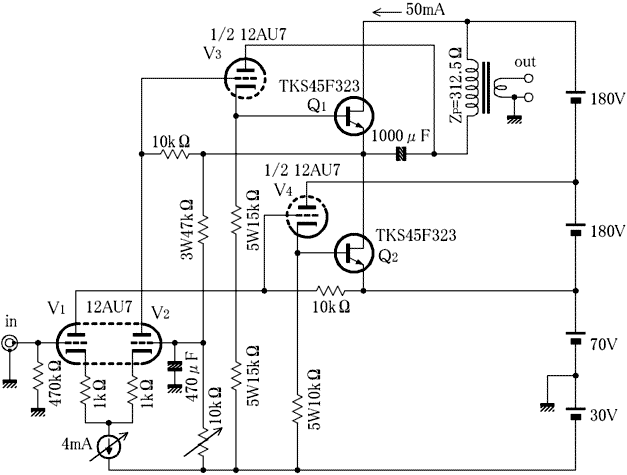
Circuit plan 1

Tamura's PP transformer F-781 can be connected in parallel because two windings of 2.5 kΩ on the primary side are independently drawn out to the terminals, and when connected in parallel, the impedance becomes 1/4 of 625 ohms.
When 8Ω is loaded on the 16Ω terminal on the secondary side, the primary side becomes 312.5Ω, so I tried to draw a load line with this.


In the gate-drain voltage 450V at maximum rating of SIT, the gate-source voltage is generally a 20V, V D -I D towards the characteristic graph V D because it is documented = 600V, equivalent of a voltage It may be strong. 

However, since it is an expensive element, I will avoid using it unreasonably.
If the operating point is V D = 180V, I D = 50mA and the load line of 312.5Ω is drawn , V D = 13V, I D = 584mA, and the maximum output is 44.6W at V GS = 0V .

Sansui Amplifiers 山水擴大機的歷史

不知為何,山水在國內外的鐵粉超多,有山水老資料庫,也有山水零件販售網,連二手拆下來的部件、PCB都賣,也很保值。相較於其他品牌,好像沒有一個品牌有那麼多人對"品牌"本身那麼瘋狂的,我的意思是,也許有人喜歡SONY某某機型、Pionner某某機型,但卻不像山水迷那樣,是對於這個品牌很執著信任,忠誠度非常高。

找了一些資料,根據已有的年份表再加以延伸
數個資料來源認為山水大約在1980~1990是黃金時期,1984年品質低谷,採用塑膠面板;後續90年代則力圖振作,但遇到日幣對美元升值、決策方向錯誤,也沒有新招可出,最後在2000年左右無力回天。


The History of Sansui Amplifiers.


Make FET like Triode: Trioderization

Trioderizer 將FET三極管化

Structurally, vacuum tube can be categorized into triode, pentode, etc. The famous tubes, like power tube WE 300B and signal tube ECC88, are triode tubes. The curve of triode, pentode are very different. After transistor is introduced to the world, we realized that FETs are more similar to pentode, instead of triode.

There are exceptions, V-FET that are invented by Japanese have triode-like curves; nevertheless, V-FETs are now obsolete and extremely rare plus expensive. V-FETs are produced in late 1970's, and are soon discontinued due to many reasons. Anyway, part of people love its sound, they think V-FET sounds "tubey", and this is the most attractive reason of getting V-FET---A transistor with vaccum sound and as powerful as common transistor!

A 300B amplifier can generate something like, say, 10 watts or so. But transistor amplifier including V-FET style, can easily generate several hundred watts.

You can call V-FET as a power tube without filament heat, that the truth.

Since V-FETs are now gone, then it comes to the question: Can we make transistors like triode?

The key to the answer might be trioderizer or solid state tube.

E-mu 0404 1212m 1616m 1820m PCI 音效卡 Windows11 驅動程式安裝 2025

E-mu 0404 1212m 1616m 1820m 音訊卡 驅動相容性與安裝 E-mu 0404 1212m 1820m等是歷久彌新的老音效卡,這些是Windows 7 時代製造且相對較老舊的音效卡。當時,AKM旭化成和 Burr-Brown 等廠商的 AD 轉換器都在爭奪板...